Kyrgyzstan is still one of the few places in Asia where backpacking feels like an actual adventure instead of a checklist. Snow-capped peaks, nomadic yurt stays, glacial lakes, and trails where you’ll see more horses than hikers. And it’s still cheap. This guide covers visas, costs, the best treks, and a route that actually works, no fluff.
Do You Need a Visa for Kyrgyzstan?
Most Western passport holders don’t need one. Citizens of around 60 countries, including the US, UK, EU, Canada, Australia, New Zealand, Japan, South Korea, and the Gulf states, get visa-free entry for up to 60 days. That’s plenty for a full backpacking loop.
If your country isn’t on the list, Kyrgyzstan runs a straightforward e-visa system at evisa.e-gov.kg, usually processed in 3-7 business days and costing roughly $40-90 depending on visa type and duration. CIS citizens (Russia, Kazakhstan, Georgia, Armenia, etc.) enter visa-free too, often for 90 days or with no formal limit.
One thing to flag for 2026: Kyrgyzstan updated some of its visa-free arrangements in late 2025/early 2026, including rolling-limit rules for a few nationalities and adjustments to the CIS unilateral visa-free allowance. The “60 days for everyone” mental model still holds for most Western passports, but always confirm your exact allowance on the official portal before booking flights. Also carry a passport valid at least 6 months beyond your entry date, some airlines check this even though Kyrgyzstan itself asks for less.
Best Time to Go
July and August are peak season and for good reason: this is the only window when high-altitude spots like Song-Kul and the Ala-Kul pass are fully clear of snow and yurt camps are actually operating. June and September are solid shoulder months, with fewer crowds and still-good weather, though nights get properly cold above 3,000m.
Outside June-September, don’t plan on high-altitude trekking. Yurt camps close down completely, and passes get snowed in. Bishkek and Issyk-Kul’s lower shoreline stay pleasant longer, and Karakol turns into a decent ski town in winter if that’s your thing.
How to Get to Kyrgyzstan
Manas International Airport (FRU) near Bishkek is the main gateway, with flights from Istanbul, Dubai, Delhi, Moscow, Almaty, and Tashkent. Osh also has an international airport with more limited regional connections.
Overland is very doable and honestly part of the fun. From Almaty, Kazakhstan, it’s a 4-6 hour trip via the Korday border crossing by marshrutka or shared taxi ($8-25 depending on how you do it). Overland routes also exist from Uzbekistan (Tashkent side) and via the Pamir Highway from Tajikistan, though the latter is a serious undertaking. Crossing from China requires advance permits and isn’t a spontaneous option.
Money, ATMs, and What Things Actually Cost
The currency is the Kyrgyzstani Som (KGS). This is a cash-based country. ATMs are everywhere in Bishkek, Osh, and Karakol, but basically nonexistent once you’re in the mountains or a village, so stock up on cash before heading out. Cards work at some city hotels and restaurants, nowhere else.
Realistic daily budgets for 2026:
- Shoestring: $25-35/day (dorm beds or basic guesthouses, local food, marshrutkas)
- Mid-range: $45-65/day (private rooms, shared taxis, an occasional guided trek)
- Comfortable: $80-120/day (boutique guesthouses, private transfers, nicer yurt camps)
Sample prices to calibrate against: a hostel dorm bed in Bishkek or Karakol runs $8-12, a basic guesthouse room $18-30, a local café meal $3-8 (street food and snacks less), and a marshrutka ride between cities $4-8.
SIM Cards and Staying Connected
Beeline, MegaCom, and O! are the three networks. MegaCom and O! generally edge out Beeline on rural and mountain coverage, though Beeline is the most reliable option in cities and the one most travel eSIMs piggyback on. A tourist SIM from an official Beeline, MegaCom, or O! counter costs around $3-6 with several GB of data, and you’ll need your passport for registration. Heads up: the first SIM desk right past customs at Manas Airport is known for charging $10-15 with a hard sell, walk a bit further to find the same product cheaper.
If you’d rather skip the registration hassle, a travel eSIM on the Beeline network works fine for cities and main roads. Prices vary a lot by provider and data amount, small bundles start around $2-6, while larger 10-20GB packages from mainstream resellers (Airalo, Saily, Holafly) run $25-40. Either way, expect signal to drop out completely above the treeline once you’re deep into a trek.
Getting Around: Marshrutkas, Shared Taxis, and CBT
Marshrutkas (shared minivans) are the backbone of Kyrgyz transport. They’re cheap, leave from bus stations “when full” rather than on a fixed schedule, and connect basically every town worth visiting. Shared taxis cost more but are faster and also leave when full.
Some routes worth knowing:
- Bishkek to Karakol: 6-7 hours by marshrutka (
$6-7) or 5-6 hours by shared taxi ($12-17). A ~55-minute flight also exists. - Bishkek to Osh: 11-13 hours by shared taxi ($30-40), sometimes stretching to 15+ hours with stops, since there’s no direct public bus on this route. A 40-60 minute flight runs $50-70.
- Bishkek to Kochkor (gateway to Song-Kul): 2.5-3 hours by marshrutka, around $4.
For treks and yurt stays, book through CBT (Community Based Tourism) offices rather than winging it. More on that below.
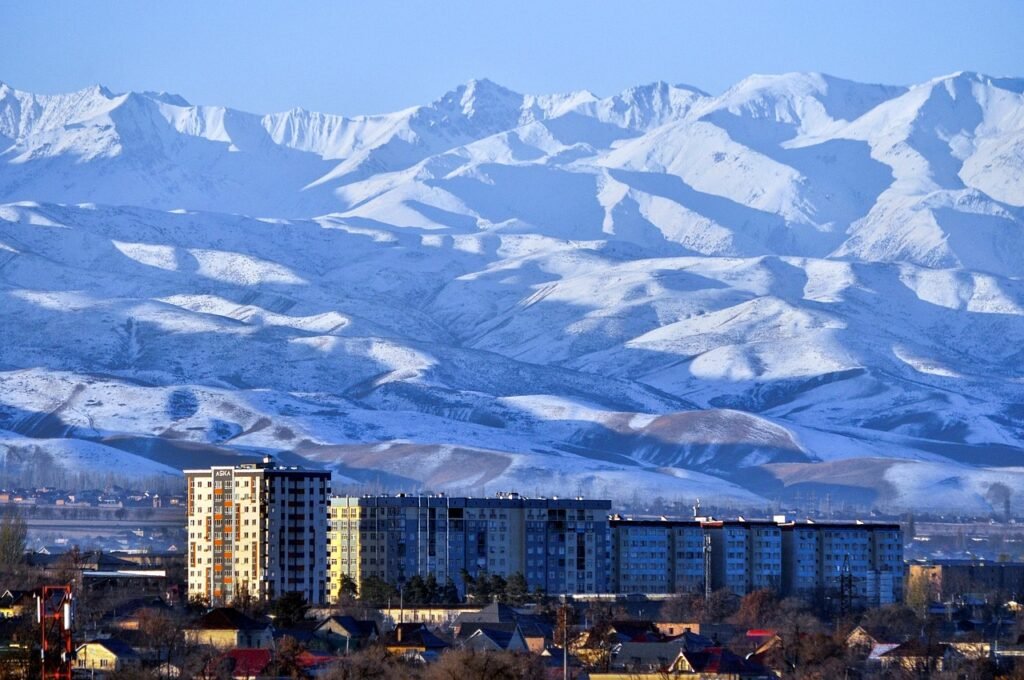
Bishkek
Be honest with yourself here: Bishkek is not why you’re coming to Kyrgyzstan. It’s a wide, leafy, fairly unremarkable Soviet-planned capital, and most backpackers treat it as a 1-2 day logistics stop, buy gear, get cash, arrange onward transport, maybe hit Osh Bazaar for cheap trekking supplies.
If you’ve got a spare day, Ala-Archa National Park is about 40 minutes from the city and makes a good acclimatization hike before heading into higher terrain. Otherwise, don’t overthink Bishkek. Get your errands done and move on.
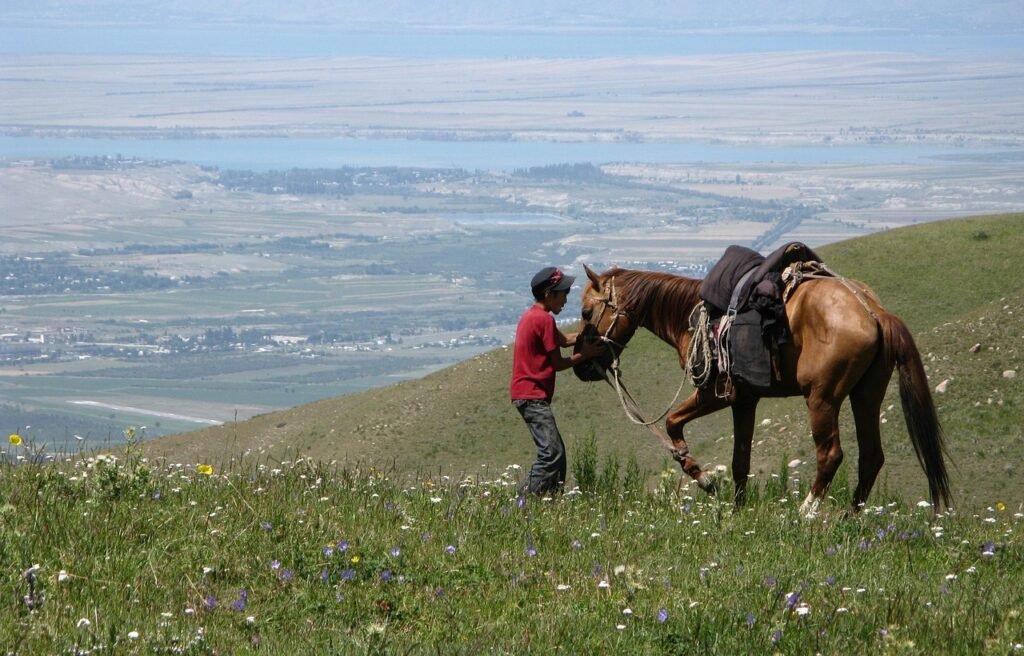
Karakol
Karakol, on the eastern edge of Issyk-Kul lake, is where the real backpacking starts. This is your base for Ala-Kul, Altyn-Arashan, and the increasingly popular Jyrgalan valley treks. The town itself has a lively Sunday livestock market (worth a visit if the timing lines up), a wooden Russian Orthodox cathedral, and a Dungan mosque built without a single nail.
Multiple trekking agencies (CBT Karakol, Ecotrek, Turkestan) run guided departures if you don’t want to go solo. Hostel dorms here run $8-12, similar to Bishkek.
The Ala-Kul Lake Trek
If you do one trek in Kyrgyzstan, make it this one. It’s a 3-4 day loop, roughly 38-45 km, climbing to a 3,860m pass before dropping to the turquoise Ala-Kul lake at 3,532m, then continuing down through the Altyn-Arashan valley to hot springs.
No special permit is required, but you’ll pay a small national park entry fee (roughly 250 KGS, about $3) at the Karakol Valley trailhead checkpoint. Budget-wise:
- Self-supported (own tent, gear, food): $50-80 total including transport, park fees, one guesthouse night, and food
- Guided with horse support for gear: $150-250 for three days
- Fully outfitted small-group tours through international operators: roughly $480-980 per person depending on group size and trip length (solo bookings sit at the top of that range, groups of 5+ near the bottom)
A guide isn’t legally required and the trail is well-marked in good weather, but it can get confusing fast in fog or fresh snow near the pass. If you’re a first-timer to Central Asian mountains, hiring one through CBT Karakol is worth it for peace of mind.
Altyn-Arashan Hot Springs
Tucked at the far end of the valley on the Ala-Kul loop, Altyn-Arashan is a cluster of basic guesthouses built around natural hot springs at around 2,600m. After days of trekking, soaking here genuinely hits different. A guesthouse bed runs around $5-6, with dinner and breakfast for another $5 or so. You can also reach it as a standalone overnight trip without doing the full Ala-Kul loop.
Song-Kul Lake: Sleeping in a Yurt at 3,000 Meters
Song-Kul is the classic Kyrgyzstan nomad experience: a huge alpine lake at 3,016m ringed by summer pastures where shepherd families move up with their herds every June through September. No hotels, no shops, no wifi, just yurts, horses, and an absurd amount of stars if you’re lucky with clear skies.
Access is via Kochkor, reached from Bishkek by marshrutka (2.5-3 hours, ~$4). From Kochkor, the CBT office arranges onward transport, horses, or a driven 4×4 to the lake. Yurt stay pricing varies by tier:
- Basic shepherd yurt (shared, no shower, pit latrine): $15-25/person/night including meals
- Mid-range tour company camps (some solar power, hot shower for a few extra dollars): $35-50/person/night
- CBT all-inclusive camps: $60-80/person/night
A 2-3 day horse trek from Kochkor to the lake with a guide, meals, and yurt included typically runs $80-120 per person. Book at least a week or two ahead in July and August since camps do fill up.
Skazka Canyon and Jeti-Oguz
On Issyk-Kul’s south shore, Skazka (“Fairy Tale”) Canyon is an easy 1-2 hour walk through red and orange sandstone formations, small entry fee, no trekking gear needed. Near Karakol, Jeti-Oguz (“Seven Bulls”) is a striking red rock ridge and an easy detour if you’re already in the area. Both are worth a visit as low-effort add-ons between bigger treks.
Osh and the South
Osh, Kyrgyzstan’s second city, feels older and more Central Asian than Bishkek. Its bazaar is one of the oldest and largest in the region, and Sulaiman-Too, a UNESCO-listed sacred mountain right in the city center, is a must for the views alone (small entry fee).
Osh is also your gateway south toward the Alay Valley and Pamir views if you want to keep going, or west toward Uzbekistan via the Dostuk border crossing.
Arslanbob
Between Osh and Bishkek near Jalal-Abad sits Arslanbob, widely described (by locals and most guidebooks) as the world’s largest natural walnut forest. It’s a laid-back stop for waterfall hikes and homestays arranged through the local CBT network, typically $8-20 per night including breakfast, and often dinner too at the higher end. Reach it by taking a marshrutka or shared taxi on the Bishkek-Osh road and getting off at Bazar-Korgon, then a short onward marshrutka to Arslanbob (roughly 1-2 hours).
Booking Through CBT (Community Based Tourism)
CBT is the backbone of independent travel in rural Kyrgyzstan. It’s a network of offices in Bishkek, Kochkor, Karakol, Naryn, Osh, and Arslanbob that connects travelers directly with local families for yurt stays, horse treks, homestays, and guides. Staff generally speak English, and the majority of what you pay stays in the local community rather than going to a middleman. Book a week or two ahead for July-August; outside that window, availability is looser but so are the yurt camps themselves, many simply aren’t set up yet.
What to Pack for Backpacking Kyrgyzstan
- Layers, including a proper insulating layer. Nights above 2,500m drop near or below freezing even in July.
- A warm sleeping bag rated for at least 0°C if you’re camping or staying in basic yurts.
- A rain shell. Mountain weather flips fast, and afternoon storms are common in summer.
- Trekking poles, especially for the Ala-Kul pass descent.
- A headlamp, water purification tablets or a filter, and a basic first aid kit.
- Cash in small denominations. Nobody in a mountain village can break a large bill.
- Offline maps (Maps.me works well) since phone signal disappears fast outside towns.
- Strong sunscreen and sunglasses. UV at altitude is no joke, even on cloudy days.
Safety Tips
Kyrgyzstan is generally a safe country for backpackers, including solo travelers, with low rates of violent crime targeting tourists. Normal precautions apply: watch your bag in bazaars and on overnight transport, and don’t flash cash.
The real risks are environmental. Altitude sickness is a genuine concern above 3,500m, so build in acclimatization days rather than rushing the Ala-Kul pass. Weather in the mountains changes fast, don’t push on toward a pass if clouds are rolling in. Some border-adjacent zones near China and Tajikistan require special permits arranged in advance, so check before planning any route that hugs those borders.
A Realistic 2-Week Backpacking Itinerary
- Days 1-2: Bishkek. Gear up, get cash, day hike in Ala-Archa National Park.
- Days 3-5: Kochkor and Song-Kul. Marshrutka to Kochkor, arrange a horse trek or 4×4 through CBT, 2-3 days at the lake.
- Day 6: Travel to Karakol (via Bishkek or direct connections, depending on season).
- Days 7-10: Karakol. Ala-Kul trek via Altyn-Arashan (3-4 days), rest day back in town.
- Day 11: Day trip to Jeti-Oguz or Skazka Canyon.
- Days 12-14: Fly or shared-taxi to Osh. Sulaiman-Too, the bazaar, optional detour to Arslanbob before flying home.
FAQs About Backpacking Kyrgyzstan
Do I need a visa for Kyrgyzstan? Citizens of around 60 countries, including the US, UK, EU, Canada, and Australia, don’t, they get up to 60 days visa-free. Everyone else can apply for an e-visa online (evisa.e-gov.kg) for roughly $40-90, usually approved within a week. Rules shifted slightly in 2026 for a few nationalities, so confirm yours on the official portal before booking.
How much does two weeks of backpacking in Kyrgyzstan cost? On a shoestring budget of $25-35/day, expect roughly $350-500 for two weeks excluding international flights. Add a guided trek or two and that climbs toward $600-800.
Is Kyrgyzstan safe for solo and solo female travelers? Generally yes. It’s one of the more relaxed countries in the region for independent travel, and CBT’s network of homestays makes solo travel easier since you’re staying with vetted local families rather than strangers.
Do I need a permit to trek in Kyrgyzstan? For the classic routes, Ala-Kul, Song-Kul, Jyrgalan, no. You’ll pay small national park entry fees at some trailheads instead. Border-zone areas near China and Tajikistan are the exception and need permits arranged ahead of time.
What’s the best trek for a first-timer? Ala-Kul. It’s demanding but well-trodden, doesn’t require technical skill, and the payoff (that lake) is worth every uphill step.
Can I drink the tap water? Not recommended anywhere in the country. Boil, filter, or buy bottled water, especially in rural areas and yurt camps where water often comes straight from a stream.
Do I need travel insurance? Yes, and make sure it covers high-altitude trekking and emergency evacuation specifically. Mountain rescue in remote valleys is not something you want to pay for out of pocket.