Bhutan is the kind of place where you step off the plane at Paro and feel the air change. It’s thin, clean and a little piney. Prayer flags snap on every ridge, farmhouses are painted with good-luck symbols, and almost everyone you meet is wearing the national dress. It isn’t cheap and it isn’t spontaneous, but it hits different from anywhere else in the Himalayas.
Costs, Visa and Entry Rules
Start here, because Bhutan’s pricing works differently from most countries.
| Item | Cost (2026–27) |
|---|---|
| Sustainable Development Fee (SDF), adults 12+ | USD 100 per person, per night |
| SDF, children 6–11 | USD 50 per night |
| SDF, children under 6 | Free |
| SDF, Indian nationals | Nu./INR 1,200 per person, per night (children 6–11 pay half) |
| Visa (non-Indian visitors) | USD 40 per person, one-time, non-refundable |
| GST on tour packages | 5% on hotels, transport and guiding. It doesn’t apply to the SDF, the visa or air tickets |
What to know about the SDF
- The USD 100 rate is a discounted rate, confirmed through 31 August 2027. The fee was USD 200 per night when Bhutan reopened in 2022, so if you’re travelling after August 2027, check what rate applies.
- It’s charged per night, not per day. A couple staying six nights pays USD 1,200 in SDF between them.
- It comes on top of hotels, food, guide, vehicle and flights.
- It’s usually paid when you apply for your visa, either through a tour operator or directly on the official portal.
Do I need a tour operator?
Not strictly for the paperwork. You can apply for your own e-visa and pay the SDF yourself. In practice, though, rules on movement are tight:
- Foreign visitors need a licensed Bhutanese guide for travel beyond Paro and Thimphu, and for treks and many sacred sites.
- Travel between towns must be in a registered private vehicle with a licensed driver. Tourists generally can’t use public buses between districts.
- Walking around town, shopping and eating out in Paro and Thimphu doesn’t need a guide.
Because of this, most visitors book a package through a licensed operator who bundles the visa, guide, driver, hotels and meals.
Other entry details
- Your passport must be valid for at least six months.
- You’ll get a visa clearance letter after approval. Carry a printed copy. The visa is stamped in your passport when you land at Paro.
- Travel insurance is reportedly no longer a visa requirement, but it’s still strongly recommended. Medical evacuation from the mountains is expensive.
- If you’re flying via India, check whether you need an Indian transit visa or a multiple-entry visa for your routing.
Getting There and Around
By air. Paro is the main international airport, and only two airlines fly in: Drukair and Bhutan Airlines. There are no long-haul direct flights, so you’ll connect through a regional hub.
- Bangkok, Delhi and Kathmandu have daily flights.
- Kolkata has several flights a week.
- Singapore is served several times a week by Drukair, with a short technical stop.
- Other routes, including Dhaka and some Indian cities, run on a limited schedule. Seasonal routes change, so check the airline sites.
- Operators reported typical one-way economy fares in mid-2026 of roughly USD 200–280 from Kathmandu, USD 220–340 from Delhi and USD 360–490 from Bangkok. Prices swing a lot by season.
- Flights from Kathmandu, Delhi and Bangkok can give you Himalayan views on clear days. Ask for a seat on the left side if you can.
- Gelephu, in the south, opened a second airport in early 2026 with very limited international service. Paro is still the main gateway.
- Domestic flights connect Paro with Bumthang (about 35 minutes), which saves a long drive.
By land. Phuentsholing, on the Indian border, is the most common overland entry. Overland travellers from India still need the right permit or visa.
Rough road times
- Paro airport to Tiger’s Nest trailhead: about 10 km, 20 minutes
- Paro to Thimphu: about 55 km, 1 to 1.5 hours
- Thimphu to Punakha: about 3 hours via Dochula Pass
- Punakha to Phobjikha Valley: about 2.5 hours
- Paro to Haa Valley: about 2 to 2.5 hours over Chele La pass
- Thimphu to Bumthang: roughly 9 to 10 hours, usually split with a night in Gangtey or Trongsa
Best Time to Visit
- March to May: Rhododendrons bloom, skies are mostly clear, and the Paro Tshechu festival falls in spring.
- September to November: Crisp air and the best mountain views. This is peak season, so book flights early.
- December to February: Cold but dry and quiet. This is also when black-necked cranes are in Phobjikha.
- June to August: Monsoon. Expect leeches, cloud and the odd landslide.
Festivals (tshechus). Dates follow the Bhutanese lunar calendar and can shift by a few days, so confirm before booking. Tentative 2027 dates:
- Punakha Tshechu: mid-February
- Paro Tshechu: around 18 to 22 March
- Thimphu Tshechu: around 10 to 12 October
- Black-Necked Crane Festival: 11 November, held every year at Gangtey Monastery in Phobjikha
Where to Go
Paro
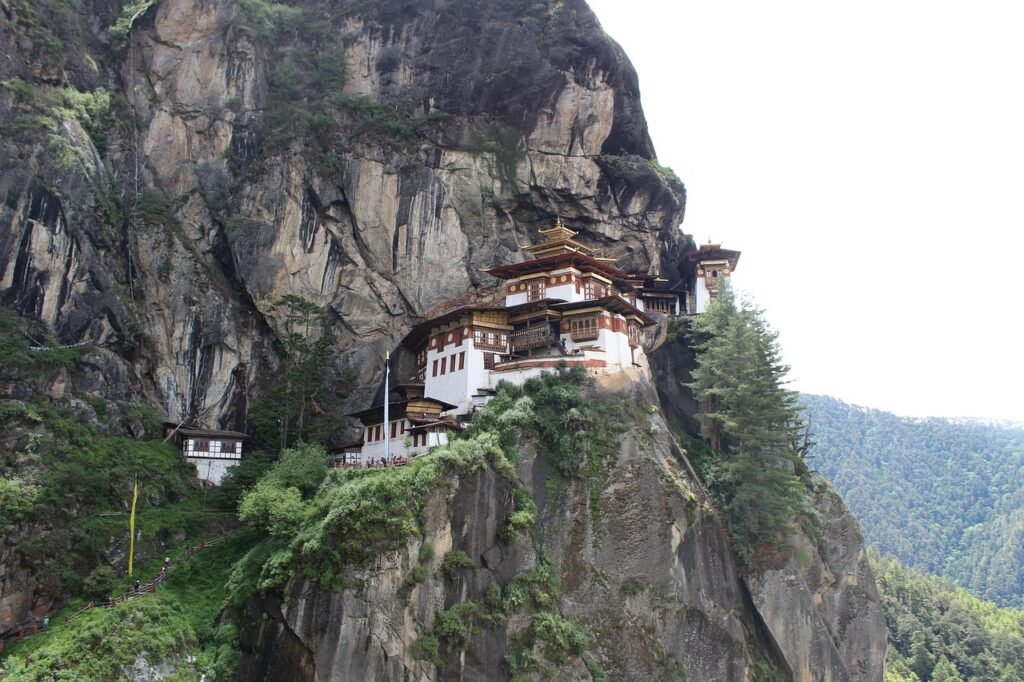
Tiger’s Nest (Paro Taktsang) is the headline act, and it’s a must. The monastery clings to a cliff about 900 m above the valley floor, at roughly 3,120 m above sea level.
- The hike: about 4 km each way, with roughly 700 m of climbing. Most people take 5 to 6 hours round trip, but anywhere from 4 to 8 hours is normal.
- Halfway point: there’s a cafeteria with a viewpoint. Ponies can carry you part of the way up, but the last stretch is on foot.
- Entry: the ticket is Nu 500 (about USD 6 to 7) for Indian visitors. For international visitors it’s covered by the SDF.
- Rules: no cameras or phones inside. There are lockers near the entrance.
- Tip: do it early in the trip only if you’ve acclimatised for a day. Many people save it for the end.
Also worth a visit are Rinpung Dzong, the covered Nyamai Zam bridge, and Kyichu Lhakhang, one of the oldest temples in the country, dating from the 7th century.
Thimphu
A capital with no traffic lights. Police direct traffic by hand.
- Buddha Dordenma: a gilded statue about 51 m tall, with big valley views.
- Tashichho Dzong: the seat of government. Don’t miss it around dusk.
- Weekend market: great for people-watching and local snacks.
- Motithang takin preserve: a chance to see Bhutan’s odd, goat-antelope national animal.
Dochula Pass
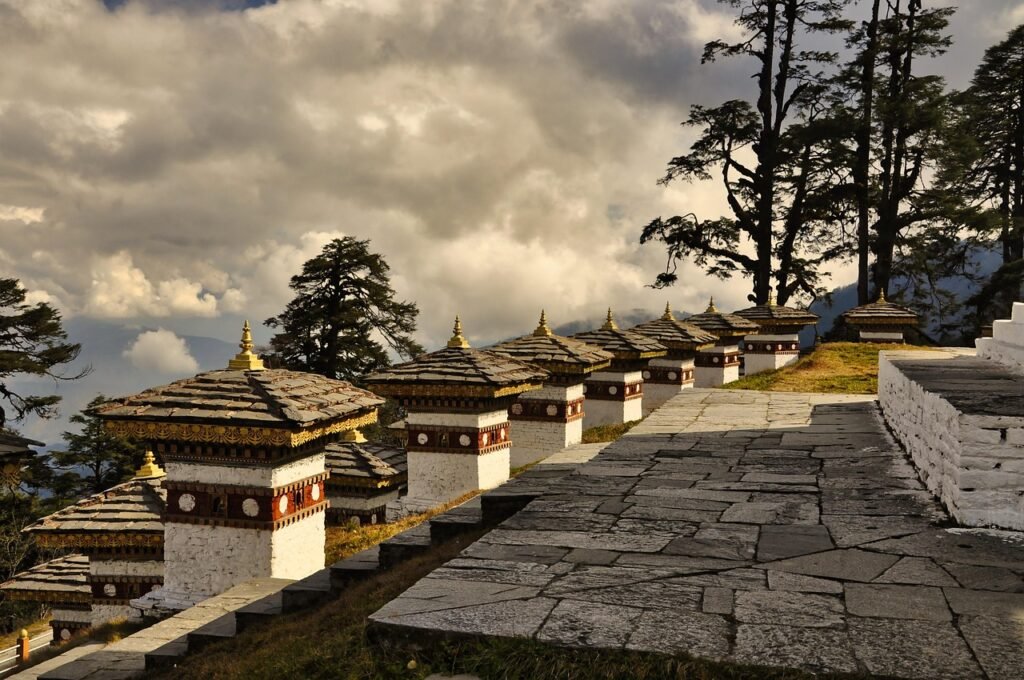
About 3,100 m on the road to Punakha, with 108 stupas. If you’re lucky, a clear morning brings a wall of snow peaks.
Punakha
Warmer, lower and greener.
- Punakha Dzong: sits where two rivers meet and is arguably the most beautiful fortress in the country.
- Suspension bridge: one of the longest in Bhutan, a short walk from the dzong.
- Chimi Lhakhang: the fertility temple, reached by a 20 to 30 minute walk through rice fields.
Phobjikha Valley
A broad glacial valley around Gangtey Monastery. Black-necked cranes arrive from the Tibetan plateau in late autumn and stay until about March. The festival on 11 November has crane dances performed by local schoolchildren. Come for easy walks, quiet farm stays and big skies.
Bumthang
The spiritual heartland, spread over several valleys, with old temples like Jambay Lhakhang and a slower pace. It’s worth the effort if you have eight days or more.
Haa Valley
Quieter and less visited. A good day trip with alpine scenery, and the road over Chele La pass is a highlight on its own.
Trekking
Multi-day treks like Druk Path and Jomolhari are popular. Trekking needs a licensed operator and proper gear, and weather in the high country can turn fast. The Trans Bhutan Trail, which has been restored for walkers, is another option for sections of hiking.
Food in Bhutan
Bhutanese food is simple, hearty and spicy. Chilies are treated as a vegetable, not just a seasoning.
- Ema datshi: chilies in melted cheese, the national dish. You’ll eat it often.
- Kewa datshi (potatoes) and shamu datshi (mushrooms) are milder versions.
- Phaksha paa: pork with dried chilies and radish.
- Red rice: nutty, slightly chewy, served with almost everything.
- Momos: dumplings, usually beef, pork or cheese.
- Suja: salty butter tea, an acquired taste.
- Ara: home-distilled rice or maize liquor, often offered at village homestays.
- Bumthang specialties: look for buckwheat pancakes and noodles.
Ask for chilies on the side if you’re sensitive. Vegetarians do fine, though meat is common. Meals are usually included in tour packages, so check what’s covered before you pay for extras.
Culture and Etiquette
Bhutan’s tourism policy is built around protecting its culture, and visitors are expected to play along.
- Dress modestly at dzongs and temples: long sleeves, long pants or skirts, no hats.
- Don’t take photos inside temples.
- Walk clockwise around chortens, mani walls and prayer wheels.
- Never point your feet at an altar or touch sacred objects.
- Locals wear the gho (men) and kira (women) daily, and you’ll see them at every office and school.
- Archery is the national sport. Matches are loud, joyful and full of singing and teasing.
- Gross National Happiness is a real guiding idea in government policy, not just a slogan.
Try a hot stone bath (dotsho) at a farmhouse. River stones heat the water, and it’s a perfect reward after a hike.
Practical Tips
- Currency: the Ngultrum (Nu), pegged one-to-one with the Indian rupee. Carry some cash for small shops and villages, because cards aren’t accepted everywhere. ATMs are mainly in Thimphu and Paro.
- Altitude: Paro sits around 2,200 m and Thimphu a bit higher. Take it easy on day one.
- SIM cards: local SIMs are available at the airport and in Thimphu.
- Power: 230V, with types D, F and G plugs.
- Time zone: UTC+6, no daylight saving.
- Weather and flights: Paro’s approach is demanding, and flights can be delayed by weather. Leave buffer time before any onward connection.
- Packing: layers, sturdy shoes, a rain jacket, sunscreen and a reusable water bottle.
FAQs
Do I need a visa for Bhutan? Yes, unless you’re an Indian national, who need an entry permit instead. The visa costs USD 40 and is usually applied for together with the SDF payment.
How much is the SDF in 2026? USD 100 per adult per night, USD 50 for children 6 to 11, and free for children under 6. Indian visitors pay Nu./INR 1,200 per night. The USD 100 rate is confirmed through 31 August 2027.
Can I travel independently? Partly. You can apply for your own visa and pay the SDF yourself, but you need a licensed guide beyond Paro and Thimphu and for treks, and you must travel between towns in a registered vehicle with a licensed driver. Most visitors use a licensed operator.
How many days do I need? Five to seven days covers Paro, Thimphu and Punakha comfortably. Add three or more for Phobjikha or Bumthang.
Is Bhutan safe? Very. Crime is low and locals are warm and helpful. The main risks are mountain roads, weather and altitude.
Is the Tiger’s Nest hike hard? It’s moderate. It’s steep in places, but doable for most reasonably fit people at a slow pace. Count on 5 to 6 hours round trip, with a cafeteria stop halfway.
Does the SDF cover everything? No. It’s a government fee. Hotels, food, guide, vehicle, flights and the 5% GST on package costs are separate.
When is the Black-Necked Crane Festival? 11 November every year, at Gangtey Monastery in Phobjikha Valley.
Can I drink alcohol? Yes. Local beer, whisky and ara are widely available.
Is travel insurance mandatory? It’s reportedly no longer required for the visa, but it’s strongly recommended. Check the latest requirement when you apply.